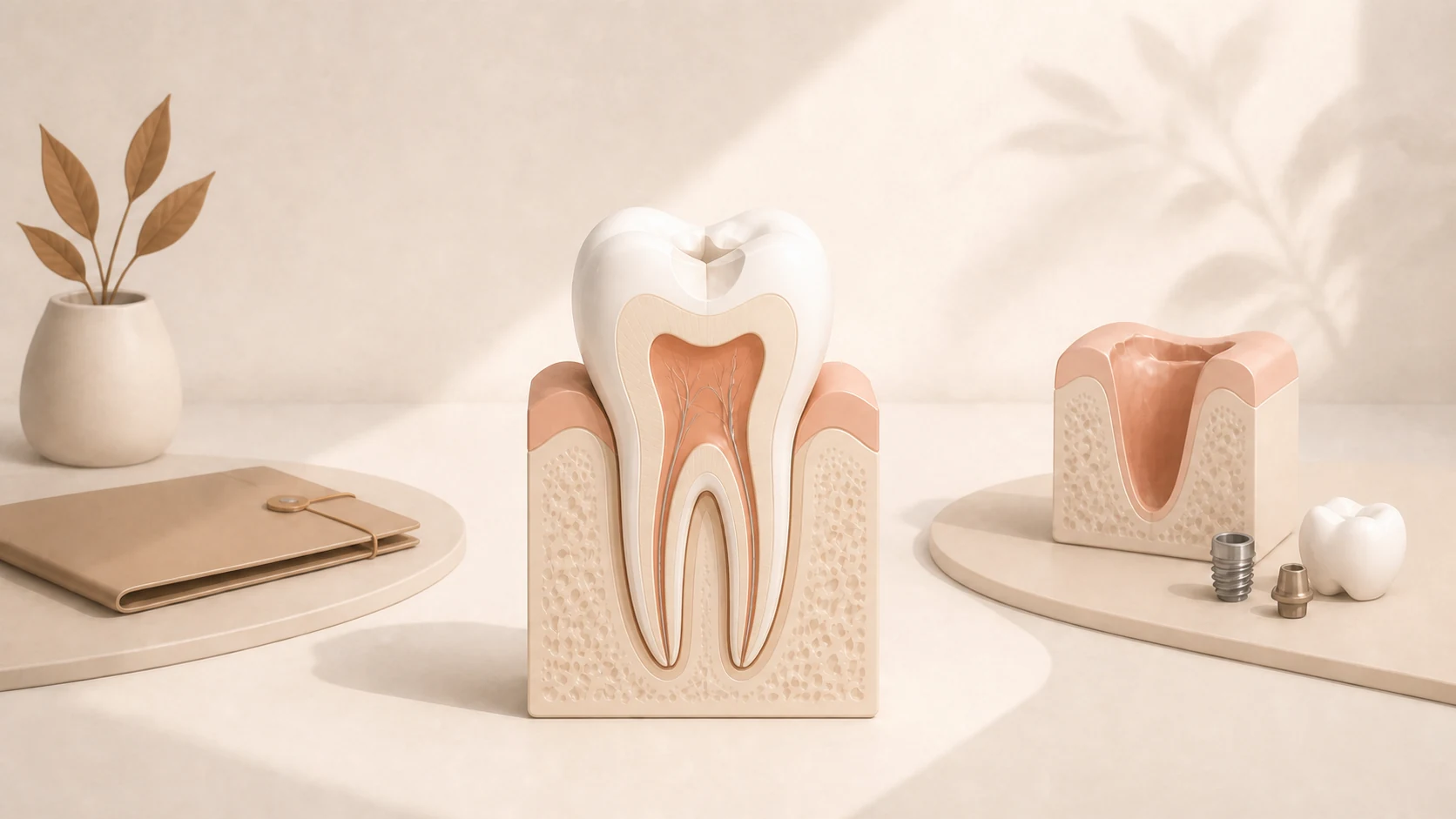
The choice between preserving and removing a tooth depends on diagnosis, restorability, and your preferences. This article explains the questions to discuss and how to compare treatment, replacement, and follow-up costs.
What is the difference between a root canal and an extraction?
Root canal treatment removes diseased pulp and cleans, disinfects, and fills the canals. The tooth is then restored for protection. Extraction removes the tooth; replacement options are considered according to its position and the needs of the bite.
The comparison includes initial treatment, restoration or replacement, and any follow-up that may be needed.
When keeping the natural tooth is appropriate
If the tooth can be restored and has a favorable prognosis, keeping it can offer these benefits:
- Natural chewing function: your tooth retains proprioception — that sensitivity that lets you regulate biting force and feel textures. Implants, no matter how advanced, do not offer that same feedback.
- Preserving support: retaining a tooth with a favorable prognosis can help preserve its supporting tissues.
- Maintaining tooth contacts: the tooth keeps its place in the bite, depending on its condition.
- Appearance: restoration aims to recover shape and function, with results depending on the case.
- Budget: compare root canal treatment and restoration with the full cost of extraction and replacement.
When is a root canal the best option?
The evaluation considers factors including:
- Decay or infection has compromised the pulp, but the tooth retains enough healthy structure to be restored with a crown or inlay.
- The condition of the roots and whether fractures prevent preserving the tooth.
- The bone support around the tooth is adequate.
- There is no advanced periodontal disease in that area.
- The patient can maintain good oral hygiene after treatment.
At Endodontics El Salvador we evaluate each case with digital radiography and an endodontic microscope to determine the real prognosis of the root canal before proposing it, and we explain it to you with the X-ray on the screen.
When is extraction recommended?
There are situations where saving the tooth is no longer possible or advisable:
- A root fracture that compromises the possibility of preserving and restoring the tooth.
- Almost total loss of the crown of the tooth, without a "ring" of healthy structure on which to seat a new crown.
- Severe root resorption, internal or external, that has consumed the root.
- Terminal periodontal disease with unrecoverable bone loss and extreme tooth mobility.
- Repeated failure of previous root canals when retreatment is no longer an option.
Root canal vs. extraction plus implant: the cost analysis
Price helps compare the indicated options but does not by itself determine which is appropriate for your tooth.
| Option | At Endodontics El Salvador | Time |
|---|---|---|
| Root canal + crown | $390 (any tooth) + $300 in zirconia or $450 in lithium disilicate = $690–$840 | Visits depend on diagnosis and laboratory needs; the crown is arranged promptly. |
| Implant, abutment, and zirconia crown | From $999. Extraction, grafting, or other additional procedures are quoted after evaluation. | Stages and follow-up depend on healing; more than one trip may be needed. |
The appropriate option considers prognosis, function, preferences, and budget. If the tooth cannot be preserved, an implant may be an alternative alongside other forms of replacement. Read more: How much does a root canal cost in El Salvador?
The "dead tooth" myth
A root-canal-treated tooth can function for many years. Its lifespan depends on its initial condition, treatment, restoration, habits, and follow-up. An identical lifespan cannot be guaranteed for everyone.
The importance of a second opinion
A second opinion allows the diagnosis to be reviewed and alternatives explained. It may confirm the recommended extraction or identify an option to preserve the tooth; it does not guarantee a different result.
If you want to understand an extraction recommendation better, you can consult an endodontist and bring previous records.
And if extraction is finally needed?
If extraction is indicated, replacement options are discussed according to the case: an implant, bridge, or denture where appropriate. Imaging needs and the quote are determined at evaluation. Read more: dental implant.
Get a second opinion before extracting
An evaluation at Endodontics El Salvador in San Miguel costs $35 and includes a digital periapical X-ray. We review your options before a decision. Initial root canal treatment costs $390 for any tooth; retreatment is quoted individually.
Last updated: .