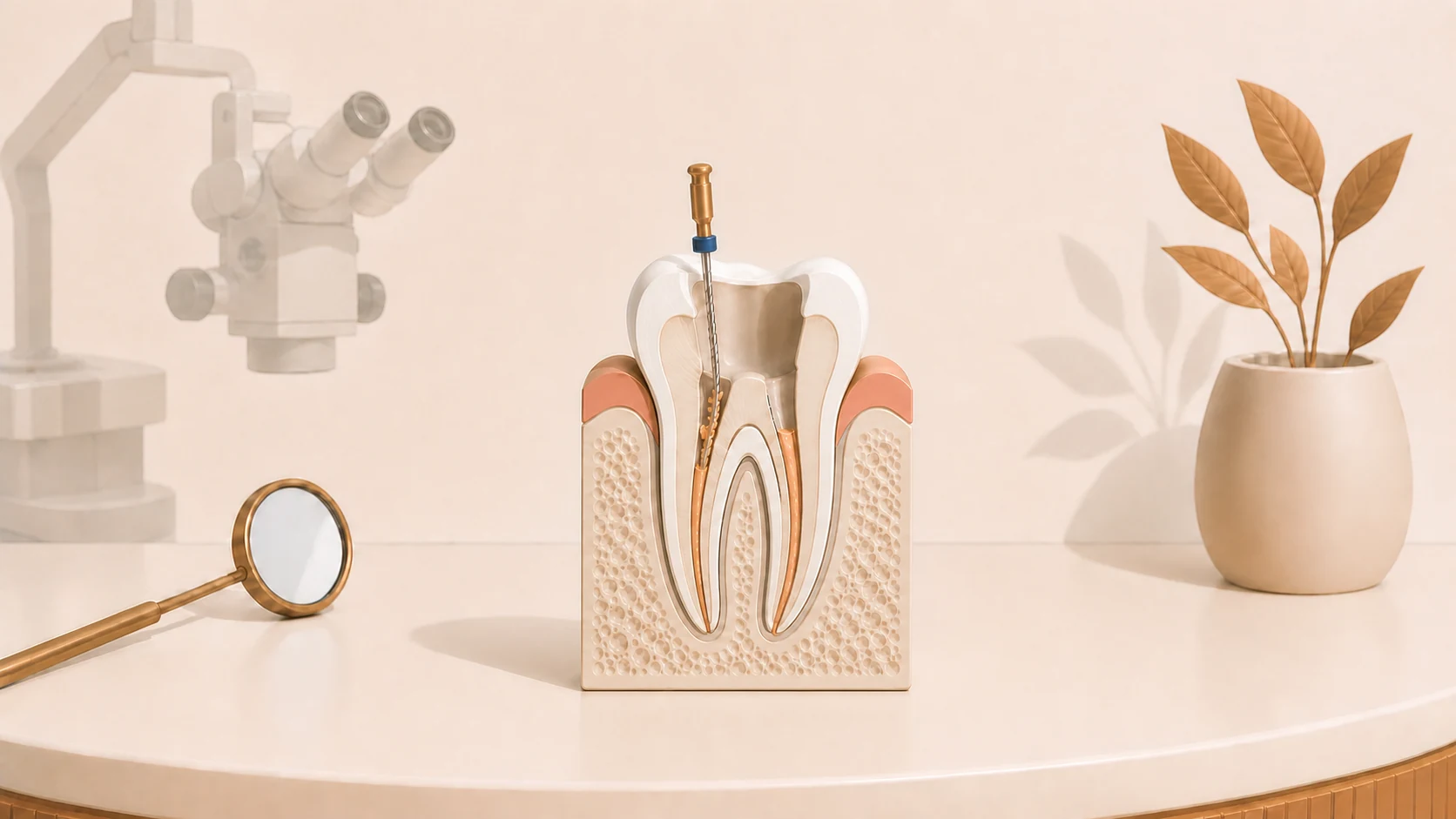
A treated tooth may function for years. If problems develop later, their cause, the restoration, and remaining tooth structure are assessed before deciding on care. Read more: endodontic retreatment.
What is endodontic retreatment?
Retreatment accesses a previously root-canal-treated tooth to remove filling material, clean and disinfect the canals, and fill them again. Its feasibility and risks are assessed first.
Why does a root canal fail?
Causes considered include:
- Unlocated canals or anatomy that could not be treated initially.
- Incomplete obturation: the material didn't reach the apex or empty spaces remained.
- Coronal leakage: the restoration on top of the tooth lost its seal and allowed bacteria to enter the treated canals.
- Root fracture: a crack allows bacterial colonization of the periapical space.
- New cavity: a recurrent cavity reaches the already-treated canals.
- Persistent reinfection: bacteria that survived the original treatment, lodged in dentinal tubules or non-instrumented isthmuses.
Changes to have checked after a root canal
- Pain when chewing on the treated tooth — new or recurring.
- Sensitivity to percussion: it hurts when the tooth is gently tapped.
- Fistula (small bump with pus) on the gum near the tooth.
- Recurring swelling in the area.
- Progressive darkening of the tooth.
- Persistent unpleasant taste around the tooth.
- Radiographic finding: new or persistent periapical lesion on routine check.
In many cases there are no symptoms and the problem is discovered only by radiograph — that's why periodic check-ups matter even on already-treated teeth.
Retreatment vs. extraction
Remaining structure, roots, periodontal support, the cause of the problem, and treatment possibilities are assessed. This information supports comparison of retreatment, extraction, and other appropriate options.
How much does root canal retreatment cost in El Salvador?
Retreatment is quoted after the $35 evaluation, which includes a digital periapical X-ray. The crown is not automatically replaced: depending on its condition and access, it may be kept, repaired, or replaced. A new crown costs $300 in zirconia or $450 in lithium disilicate. If extraction is indicated, replacement options and additional procedures are quoted. Read more: implant.
The process step by step
- Clinical and radiographic evaluation of the tooth and restoration.
- Access: the clinician assesses whether access through the restoration is possible or it needs removal.
- Removal of previous material as needed and feasible.
- Re-instrumentation: cleaning with modern rotary files, looking for canals that may have been missed.
- Irrigation to support cleaning and disinfection of the canals.
- Medication between visits when indicated, with the product and duration determined individually.
- Filling the canals after preparation.
- Final restoration: repair or replacement according to the tooth and crown’s condition.
The number of visits depends on complexity and treatment response. It may be more involved than initial treatment because of existing material and restorations.
The microscope in retreatment
The microscope helps reveal previous material and locate canals. Removing posts or instruments can carry risks; visibility does not guarantee removal without damaging the tooth.
What affects the prognosis
Prognosis depends on diagnosis, access, remaining structure, and restoration. If apical surgery is needed, the clinic refers the case to the appropriate professional.
Don't resign yourself to extraction without a second opinion
The evaluation covers options, their limits, estimated visits, and the quote. The plan may change according to findings and treatment response. Read more: endodontic retreatment.
Last updated: .