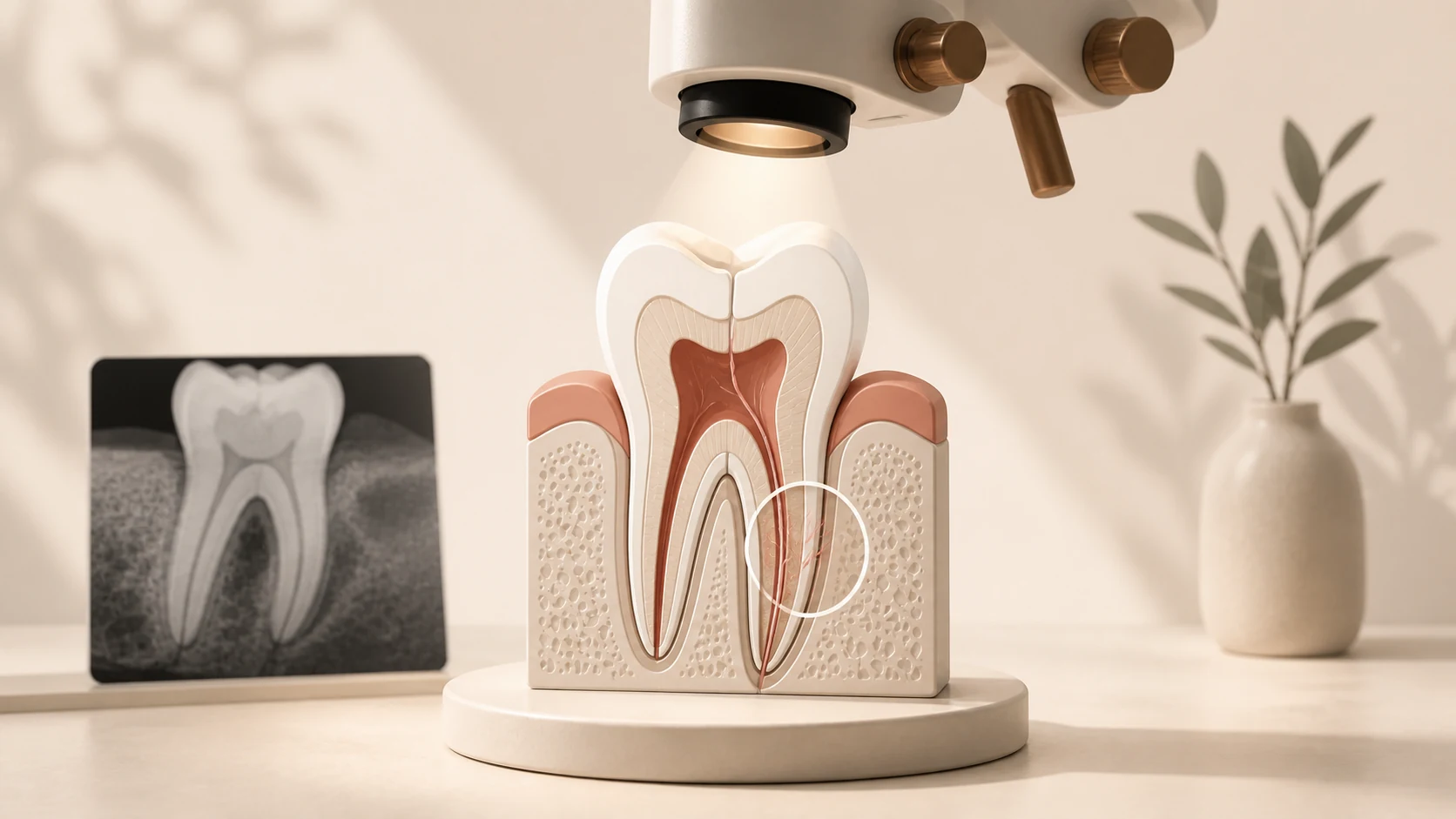
An extraction recommendation can raise questions. A consultation allows the findings and prognosis to be reviewed; a second opinion may also confirm that extraction is appropriate.
The quiet shift in endodontics
Endodontics uses tools that help assess and treat the inside of a tooth. Their value depends on the case; none alone guarantees that a tooth can be preserved.
1. Endodontic microscope
The microscope provides illumination and magnification to observe details and look for canals that are difficult to locate. It cannot reveal every fracture or resolve every anatomical challenge.
2. Nickel-titanium rotary system
Nickel-titanium files help instrument curved canals. Their flexibility does not eliminate procedural risks such as instrument separation or perforation.
3. Electronic apex locator
The apex locator helps determine working length alongside X-rays and clinical findings.
4. Cleaning and irrigation
Irrigation solutions complement instrumentation. They are used to clean and disinfect the canal system, with technique selected according to the case.
5. Root filling and restoration
After cleaning, the canals are filled with suitable materials and the restoration is planned. No technique can promise a perfect seal of every branch.
Situations requiring individual evaluation
These findings may have different options; the prognosis is explained after evaluation:
- Symptoms or lesions after root canal treatment: retreatment may be an option after evaluation.
- Calcified canals: location and access can be difficult; possibilities and risks are assessed.
- Lesions around the root: diagnosis and treatment response are assessed. If apical surgery is required, the clinic refers the case.
- Cracks or fractures: location and extent affect whether the tooth can be restored.
- Resorption: treatment depends on its location, extent, and the condition of the tooth.
- Separated instruments: their location and the tooth’s condition are assessed; attempting removal can also carry risks.
Why does it matter to save the natural tooth?
Keeping a tooth with a favorable prognosis can preserve its function and supporting tissues. Options are compared taking into account:
- The biting feedback provided by the natural tooth’s support.
- Physiological bone maintenance: the root naturally stimulates bone.
- The bite, neighboring teeth, and the restoration needed.
- The quote: initial root canal treatment and crown, $690–$840. Implant, abutment, and zirconia crown, from $999; extraction or other procedures are quoted according to the case.
- The visits, laboratory time, and follow-up required for each option.
What a second opinion can clarify
The consultation allows the initial recommendation to be reviewed and options explained. It does not assume the previous clinician was wrong or promise to change the diagnosis.
The $35 evaluation includes a digital periapical X-ray. The options, their limits, and the quote for indicated treatment are explained.
What you should ask before accepting an extraction
- Has this tooth been evaluated by an endodontist with an endodontic microscope?
- Has root canal retreatment been considered?
- What is the real prognosis of each option?
- What is the replacement plan if it is extracted?
If the answers don't reassure you, get a second opinion.
Get a second opinion before extracting
If you have questions about an extraction, arrange an evaluation and bring previous records. We assess whether an option exists to preserve the tooth and what each option involves. Read more: Root canal or extraction?
Last updated: .